
Paul K. Mengert
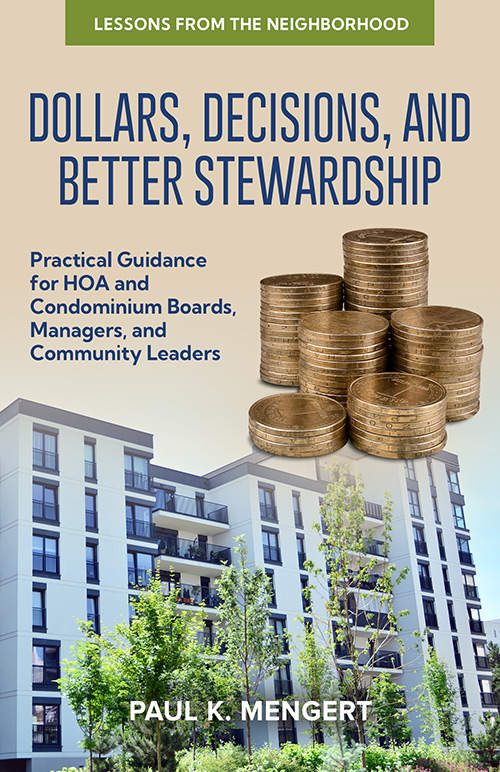
Managing the finances of a community association is about far more than keeping costs low. It requires long-term planning, careful decision-making and a clear understanding of how today's financial choices can affect homeowners years down the line. In his latest book, Dollars, Decisions and Better Stewardship, community association management expert Paul Mengert shares practical lessons drawn from decades of experience.
The book is the second in Mengert's Lessons from the Neighborhood series, which aims to share real-life experiences and practical advice with community association managers and board members. In a recent conversation with Matt Bird on the PublishU podcast, Mengert explained why financial stewardship is one of the most important responsibilities facing community associations.
One of the central messages of Dollars, Decisions and Better Stewardship is that communities do not necessarily fail because they lack money. Instead, they can find themselves short of money because they do not understand their finances properly.
Mengert points out that financial problems in community associations often develop slowly. Utility, insurance and maintenance costs may rise while homeowner assessments remain unchanged. Keeping fees low can appear to be a success, particularly when homeowners appreciate not having to pay more. However, there can be a significant hidden cost.
When an association does not increase its assessments in line with rising expenses, it may also fail to set aside enough money for future projects. Roads, roofs, clubhouses and other shared assets eventually require substantial investment. Without adequate reserves, homeowners can face unexpected financial demands when those expenses arrive.
This is where good financial stewardship becomes essential. Board members need to look beyond the immediate satisfaction of keeping assessments low and consider the long-term financial health of their community.
Mengert's book is filled with real-world stories that demonstrate how easily financial mistakes can happen. One particularly memorable example involved an association that had been paying a traffic-light utility bill that should have been the city's responsibility.
The developer had never transferred the traffic light to the city, and the association had continued paying the bill for years.
The story illustrates an important lesson: simply taking last year's budget and adding a percentage for inflation is not necessarily good financial management. Before increasing expenses by two or three per cent, board members and managers should establish whether those expenses are actually legitimate and accurate.
Going back to the basics can uncover costs that should never have been included in the budget in the first place.
While some financial mistakes can be amusing in hindsight, others can have devastating consequences. Mengert also describes a case involving an association that lost $68,000 after a sophisticated email scam.
A treasurer received what appeared to be an email from the community manager instructing him to wire money to a roofing contractor. However, one character in the sender's email address had been changed to a Cyrillic character, making the fraudulent address extremely difficult to spot.
The bank details had also been altered, and the money was ultimately transferred to the fraudster.
The incident highlights the growing importance of cybersecurity for community associations. Fraudsters can monitor email accounts, identify upcoming transactions and then create highly convincing requests for payment.
Mengert recommends that association leaders speak to their insurance professionals to establish whether their existing policies provide appropriate protection against this type of cyber fraud. Traditional crime coverage may not necessarily cover losses resulting from fraudulent email instructions.
For community associations, understanding insurance coverage should therefore be an important part of financial stewardship.
For anyone joining a community association board, Mengert recommends focusing on four key areas.
First, understand the operating budget. Board members need to know where the association's everyday income comes from and how those funds are being spent.
Second, understand the reserve budget. Reserves provide the financial foundation for major future repairs and replacements.
Third, understand the reserve study. It is not enough to know how much an association is currently saving. Board members need to understand how those figures were calculated and whether the underlying reserve study reflects today's construction and replacement costs. A study based on figures from a decade ago may no longer provide an accurate financial picture.
Fourth, understand delinquency. An association may have a carefully prepared budget, but that budget only works if homeowners actually pay their assessments. If an association expects to collect $1 million but only receives 90 per cent of that amount, the financial plan can quickly come under pressure.
Together, these four areas provide a valuable foundation for responsible community association governance.
Dollars, Decisions and Better Stewardship follows the first book in the Lessons from the Neighborhood series, which focuses on governance. Future books will explore maintenance responsibilities and better decision-making.
Mengert's objective is not simply to add another collection of industry resources. Instead, he draws on several decades of experience working in the community association management industry to share situations that managers and board members may encounter themselves.
The value of these real-life lessons is their ability to help readers recognise potential problems before they become expensive ones.
Ultimately, good community association management depends on looking beyond today's decisions and considering tomorrow's consequences. Whether it is budgeting for future repairs, reviewing insurance coverage, checking who is responsible for a utility bill or protecting against cyber fraud, better stewardship starts with asking the right questions.
For community association boards and managers, the lessons in Dollars, Decisions and Better Stewardship offer a practical reminder that responsible financial management is not simply about spending less. It is about understanding the money, planning for the future and making decisions that protect the community for years to come.
Buy your copy...
Buy your copy...

Buy your copy...