
Quick answer: Authors today have three real paths to publication; traditional publishing, self-publishing, and hybrid publishing. Traditional publishing offers prestige and production quality but takes 18–24months and pays authors roughly 10% royalties. Self-publishing offers speed and control but leaves authors fully responsible for quality and marketing. Hybrid publishing, the model PublishU pioneered, combines professional production with self-publishing's efficiency, typically 100 days from manuscript to global publication, plus author royalties of around 35%.
By Matt Bird, Founder & CEO of PublishU. Matt has helped hundreds of first-time and serial non-fiction authors publish and market their books, and has spoken on publishing and authorship in over 50 countries.
For most of the 20th century, traditional publishing houses controlled who got published. Manuscripts were judged by committees and most authors were rejected.
That changed in the late 1990s. Print-on-demand (POD) technology made it financially viable to print small quantities of books without warehousing costs and self-publishing emerged as a genuine alternative. For the first time, authors could control how, when and where their books reached readers, without needing a publisher's approval.
Today, a third model has matured: hybrid publishing, which blends the production standards of traditional publishing with the efficiencies and economics of self-publishing.
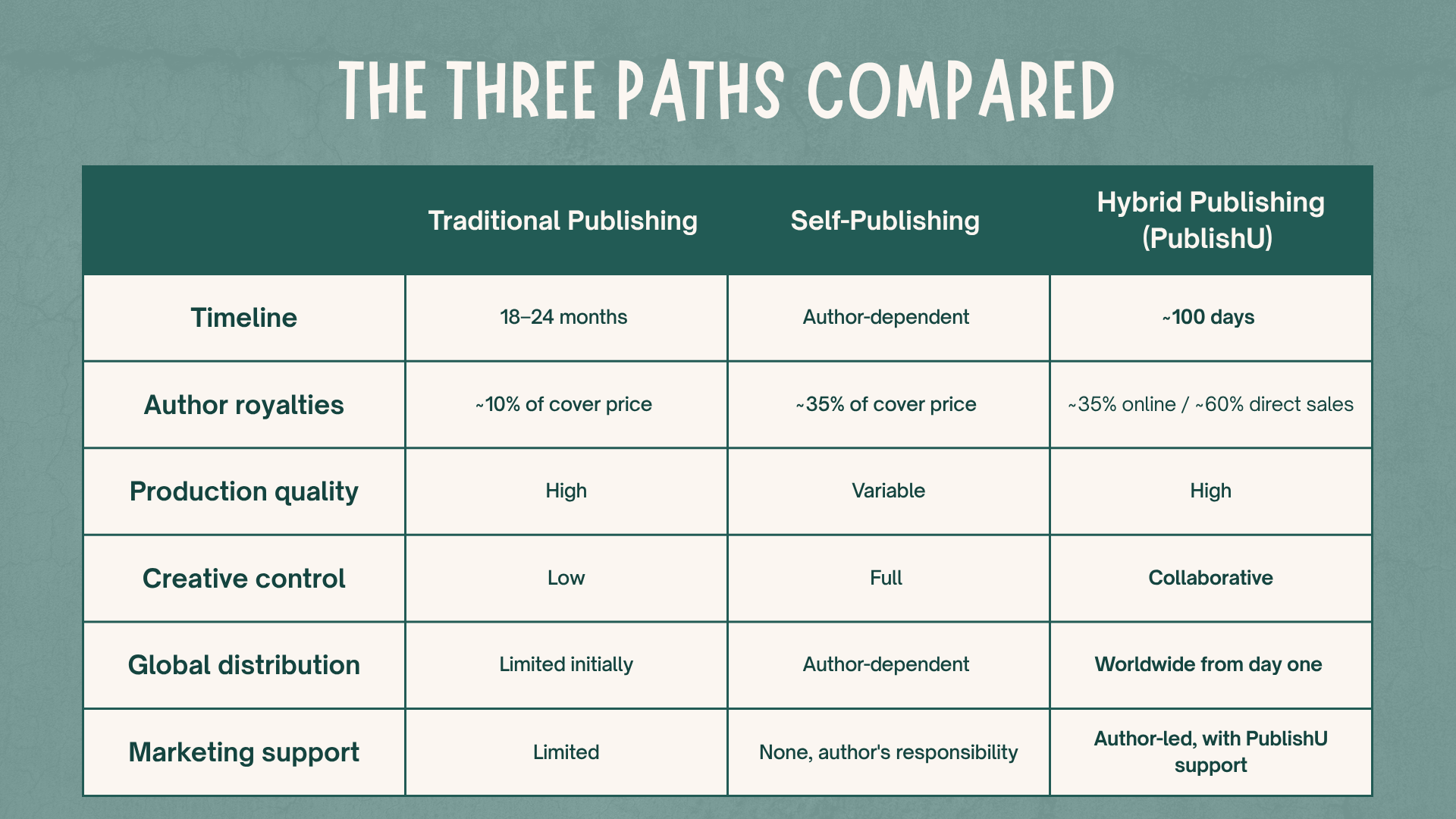
Traditional publishers remain known for production quality: professional cover design, copy-editing, proof reading and typesetting.
Historically, publishers paid authors an advance, a sum paid upfront against future royalties. For example, a £1,000 advance on a £10 book with a 10% royalty would require 1,000 copies sold before the author earns anything further. Increasingly, publishers now ask authors to commit to purchasing a set number of copies upfront instead, reducing the publisher's financial risk on unproven authors.
Book shop placement is often overstated as a benefit. Book shops don't sell books, they stock books that sell. A title that doesn't move quickly is rarely restocked.
The three main limitations:
Access to traditional publishers is almost always through a literary agent, as most publishers no longer accept direct submissions.
Self-publishing puts the author in full creative control, over the cover, the editing process, the timeline and the final product. It also offers far better economics, with royalties of around 35% of the cover price (£3.50 on a £10 book).
The two main limitations:
Hybrid publishing was built to solve the trade-off between traditional and self-publishing, combining professional production with the speed, control and economics of self-publishing.
Six core advantages:
The trade-off: as with self-publishing, the author carries primary responsibility for marketing. Traditional publishers' marketing support is often thinner than authors expect; hybrid publishing is upfront about this from the start, while offering structured support to help authors build their own audience.
Royalty percentage only tells half the story. Upfront cost and who carries the financial risk, matters just as much.
Traditional publishing: Usually no upfront cost to the author, since the publisher funds editing, design and production. In exchange, the author gives up control over the cover, title and timeline, and earns the lowest royalty rate of the three models. Some publishers now ask authors to pre-purchase a set number of copies, shifting some of that risk back onto the author.
Self-publishing: The author funds everything directly, editing, cover design, formatting, ISBN registration and any marketing. Costs vary enormously depending on quality, but a professionally produced self-published book typically requires several thousand pounds of upfront investment, with no guarantee of return.
Hybrid publishing: The author pays a fee that covers professional cover design, editing, proofing and production, in exchange for retaining higher royalties and global distribution from day one. The upfront cost is generally lower than fully outsourcing self-publishing to freelancers, because the process and team are already in place.
Take a book selling at £15, with 1,000 copies sold — a realistic first-year target for a well-marketed non-fiction title.
.png)
The gap widens further at scale, since traditional publishers' 10% rate rarely improves until an author has sold tens of thousands of copies.
The right model depends on what the author is optimising for, not just royalty rate:
What is the difference between self-publishing and hybrid publishing?
Self-publishing gives the author full control and full responsibility for every step, including production quality. Hybrid publishing provides professional production and global distribution while preserving the author's speed and royalty advantages.
How long does traditional publishing take?
Typically 18–24 months from signed contract to publication, plus several months to secure the contract itself — often two years in total from first approach to finished book.
What royalties do authors typically earn?
Around 10% of the cover price in traditional publishing, and around 35% in self-publishing and hybrid publishing models such as PublishU's.
Do I need a literary agent to get published?
Only for traditional publishing, where most major publishers accept submissions exclusively through agents. Self-publishing and hybrid publishing require no agent or gatekeeper approval.
Is hybrid publishing the same as vanity publishing?
No. Vanity publishing typically charges authors high fees for production with little quality control or distribution. Hybrid publishing combines professional editorial and design standards with transparent royalty structures and genuine global distribution.
How much does it cost to self-publish a book?
Costs vary widely depending on quality, but professionally edited, designed, and formatted self-published books typically require several thousand pounds in upfront investment, covering editing, cover design, formatting, and ISBN registration.
Can I move from self-publishing to traditional or hybrid publishing later?
Yes. Many authors self-publish a first edition to prove demand, then move to a hybrid or traditional model for a relaunch, second edition, or follow-up title, once they have sales data and an existing readership to show.
What is the biggest risk with hybrid publishing?
The main risk is the same as with self-publishing: the author carries primary responsibility for marketing. Production quality and distribution are no longer the bottleneck, so the success of the book depends heavily on the author's ability to build and reach an audience.
PublishU is a hybrid publisher helping first-time and serial non-fiction authors write, publish, and market their books globally. Learn more at [publishu.com].