
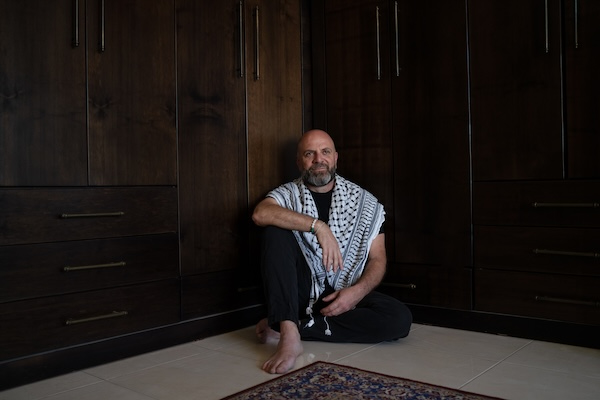
Sami Awad
When people think of the Middle East, they often imagine a region defined by division, conflict, and endless cycles of mistrust. But every so often, a story emerges that challenges this narrative and shines light on the possibility of peace. This is the story of Sami Awad, a Palestinian Christian from Bethlehem, whose life and work are a testament to resilience, reconciliation, and hope.
Recently featured on the PublishU Podcast, Sami shared his journey as an author and peacebuilder, reflecting on his book The Sacred Awakening. His story is deeply rooted in heritage, faith, and an unwavering commitment to nonviolence.
Sami’s story begins in Bethlehem, a city steeped in history and symbolism. Growing up as a Palestinian meant living under the shadow of conflict. His family, like many others, bore the consequences of displacement and occupation. Yet rather than allowing bitterness to take root, Sami found himself searching for ways to transform pain into purpose.
That transformation was influenced by his family’s deep Christian faith. He describes his identity as not only Palestinian but also shaped by the teachings of peace, forgiveness, and justice found in his tradition. This duality—faith and heritage—would later guide him as he stepped into his life’s calling.
One of the most powerful moments Sami recalled in the podcast was an introduction at a conference years ago. Standing beside a Jewish rabbi, he was introduced to an audience as both “my enemy and my friend.” The words stunned the room. In a region where identities are often reduced to political and religious labels, that introduction captured the paradox of coexistence: the possibility of friendship between two people whose communities have long been divided.
Sami reflected on how such encounters invite us to see beyond labels. He reminded listeners that reconciliation begins with courageous conversations and the willingness to see the humanity in the “other.”
Sami’s book, The Sacred Awakening, is not simply a memoir but a roadmap toward healing and wholeness. At its heart, it asks: how can individuals and communities awaken to their sacred responsibility for peace?
He describes awakening as both a personal and collective journey. For Sami, it means confronting his own pain while refusing to pass it on to future generations. For communities, it means creating spaces where reconciliation is possible, where trust can be rebuilt, and where peace is nurtured despite political realities.
What makes The Sacred Awakening particularly powerful is its insistence that peace is not passive. It requires intentional choices, forgiveness, and the courage to love in the face of hostility.
Throughout the conversation, Sami emphasized his commitment to nonviolence—not just as a strategy but as a way of life. Influenced by global figures such as Mahatma Gandhi and Martin Luther King Jr., he believes that sustainable peace can only be achieved through nonviolent resistance.
This path is far from easy. Nonviolence, he explained, demands discipline, patience, and a deep sense of faith. It often means standing unarmed in the face of aggression and choosing love over retaliation. Yet, as Sami points out, history shows us that nonviolence can dismantle systems of oppression and build bridges of reconciliation.
Another key theme from Sami’s story is identity. He speaks proudly of being Palestinian, but also as someone whose life bridges different worlds. His Christian faith connects him with communities across the globe, while his Palestinian heritage roots him in the struggles and hopes of his people.
This complex identity enables Sami to embody what he calls “the ministry of presence”—the act of simply being present in spaces of division, carrying the message that humanity is larger than any wall, border, or ideology.
In today’s climate of polarization—whether in the Middle East or beyond—Sami’s message resonates profoundly. He reminds us that reconciliation is possible when we move beyond fear and suspicion. His life and book challenge readers to ask themselves:
The story of Sami Awad is more than a regional tale—it’s a universal invitation. The Sacred Awakening calls us to look inward, to confront our own biases, and to embrace a vision of peace rooted in love and justice.
As Sami so beautifully embodies, peace is not merely the absence of conflict but the presence of reconciliation, forgiveness, and hope. And while the challenges remain daunting, his journey proves that one person’s commitment to nonviolence and reconciliation can ripple outward, inspiring others to join in the work of healing.
In a time when division often dominates headlines, Sami’s story stands as a beacon: a reminder that even in the most unlikely places, peace can be born, nurtured, and sustained.

Buy your copy...