
Helena Day
What if the very patterns that helped you become successful are now the ones preventing you from growing?
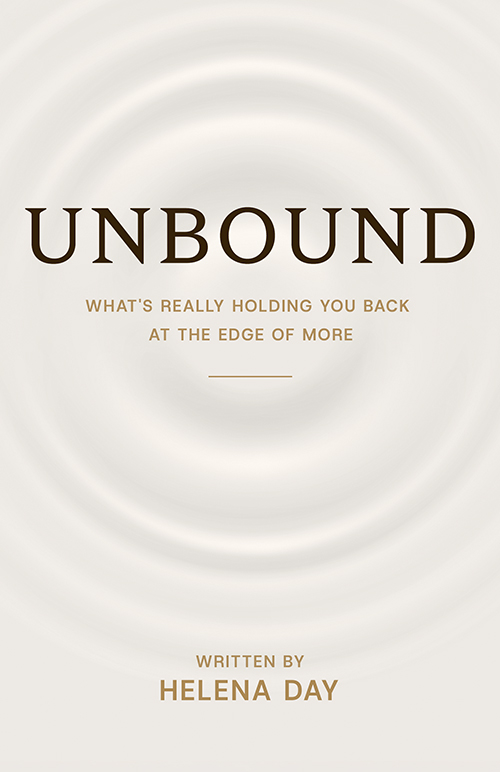
In a recent episode of the PublishU Podcast, Matt Bird speaks with author and subconscious mastery coach Helena Day about her first book, Unbound: What’s Really Holding You Back at the Edge of More. Joining the conversation from Bali, where she lives with her family, Helena explores the subconscious patterns that can quietly limit founders, leaders and high achievers — often without them realising it.
For Helena, Unbound has been a decade in the making. Although she had long imagined becoming an author, she did not begin the writing process with a perfectly defined book in mind. Instead, the central idea emerged as she created the time and space to examine the patterns she had repeatedly encountered through years of coaching leaders around the world.
At the heart of Unbound are four subconscious patterns Helena calls "binds": the Standards Bind, the Pace Bind, the Receiving Bind and the Exposure Bind.
These patterns can be particularly difficult to recognise because they often disguise themselves as qualities that society rewards. High standards, ambition, independence and visibility can all contribute to success. But when they are driven by deeper feelings of inadequacy, fear or the need to prove our worth, Helena argues that they can eventually become limiting.
As she explains in the interview, we may believe that we are freely living our lives when, in reality, we are repeatedly acting out deeply ingrained patterns.
The Standards Bind asks: Can I be imperfect and still belong?
For high achievers, perfectionism can easily be mistaken for excellence. Helena does not suggest that having high standards is inherently negative. The distinction lies in where those standards come from. When excellence grows from genuine self-belief, it can be productive. When it becomes a way of compensating for an internal feeling of not being good enough, it can become restrictive.
Interestingly, Helena experienced this bind herself while writing Unbound.
During the writing process, Helena booked herself three days alone in the Balinese jungle. Away from her children, pets and normal routines, she expected the dedicated time to create the perfect conditions for writing.
Then, on the first day, nothing came.
Her frustration eventually led her to sit beside a river and question why she could not produce the work she had specifically created space to complete. The answer became part of the lesson of the book itself: not everything can be forced.
Her desire to continually edit, perfect and control the process reflected the very Standards Bind she was writing about. Only when she began allowing rather than forcing could the book start to flow.
It is a revealing example of why Unbound is not presented simply as a theoretical framework. Helena's own experience of writing the book required her to confront many of the same patterns she was describing.
The Pace Bind is another pattern that may be familiar to founders, executives and ambitious professionals. Helena frames its central question as: Can I slow down and still matter?
When a person's sense of value becomes closely tied to productivity and achievement, slowing down can feel uncomfortable. Someone may go on holiday determined not to work, for example, only to find themselves checking emails within 24 hours.
The problem is not ambition itself. It is what happens when the pace begins controlling the person rather than the person controlling the pace.
Helena sees this repeatedly among the founders and leaders she coaches. Without the ability to consciously slow down, relentless achievement can eventually lead to burnout.
The other binds explore our relationship with receiving support and with exposure. Helena describes the Exposure Bind in terms of how visible or successful we allow ourselves to become without feeling that we will somehow be "called back". The Receiving Bind, meanwhile, became apparent during her own writing journey when she had to examine her willingness to accept the support she needed.
One of the most important distinctions Helena makes during the conversation is that Unbound is intended to be experiential rather than purely theoretical.
Throughout the book, readers encounter practical tools, activities and reflections designed to help them identify and work with their own patterns.
This matters because insight by itself does not necessarily create change. It is entirely possible to recognise a behaviour, understand why it exists and then continue repeating it. Helena therefore designed Unbound so that readers are encouraged to do the work as they progress through the book rather than simply accumulating information.
Her own writing process followed much the same path. Through PublishU's Writing My Book programme, she had the structure and accountability to continue when her own binds appeared — whether through perfectionism, expectations about how quickly she should write, difficulty receiving support or anxiety around becoming more visible through publishing her ideas.
Perhaps the most memorable metaphor Helena shares with Matt is that of the diamond.
She describes people as diamonds that gradually become covered with layers of "grime" through life. Personal growth, from this perspective, is not necessarily about transforming ourselves into an entirely different person or reaching some distant, improved version of ourselves.
Instead, it is about removing what has accumulated around us.
For Helena, that represents a significant shift from the way she once understood personal development. Rather than constantly trying to reach another destination or become somebody different, Unbound proposes that growth can mean releasing the patterns that obscure who we already are.
That philosophy also shapes Helena's view of what may come next. When Matt asks what a second book might explore, she does not have an answer — and that is precisely the point.
One of the central lessons she took from writing Unbound was to stop forcing and pushing. As she explains, contraction has to be released in order for expansion to occur.
Her first book emerged through that process of allowing. If another follows, she intends to let it unfold in much the same way.
Unbound ultimately asks readers to consider an uncomfortable but potentially powerful possibility: what if moving forward does not require pushing harder?
Perhaps the next stage of growth begins by recognising what has been quietly holding us back — and learning how to release it.
This article is based on an interview with Matt Bird, founder of PublishU, helping first-time and serial non-fiction authors to write, publish and market books worldwide.
Connect with Matt on Instagram 👉🏼 CLICK HERE or LinkedIn 👉🏼 CLICK HERE
Buy your copy...